01
RAG with source attribution, not free generation
Every AI answer points at the concrete document and the exact passage. People only trust the AI if they can verify — and in construction that's not negotiable.
Valiro connects office and field teams at construction, plant engineering, and engineering firms. A platform I work on daily — and one that flows directly into my consulting for industrial mid-market clients.
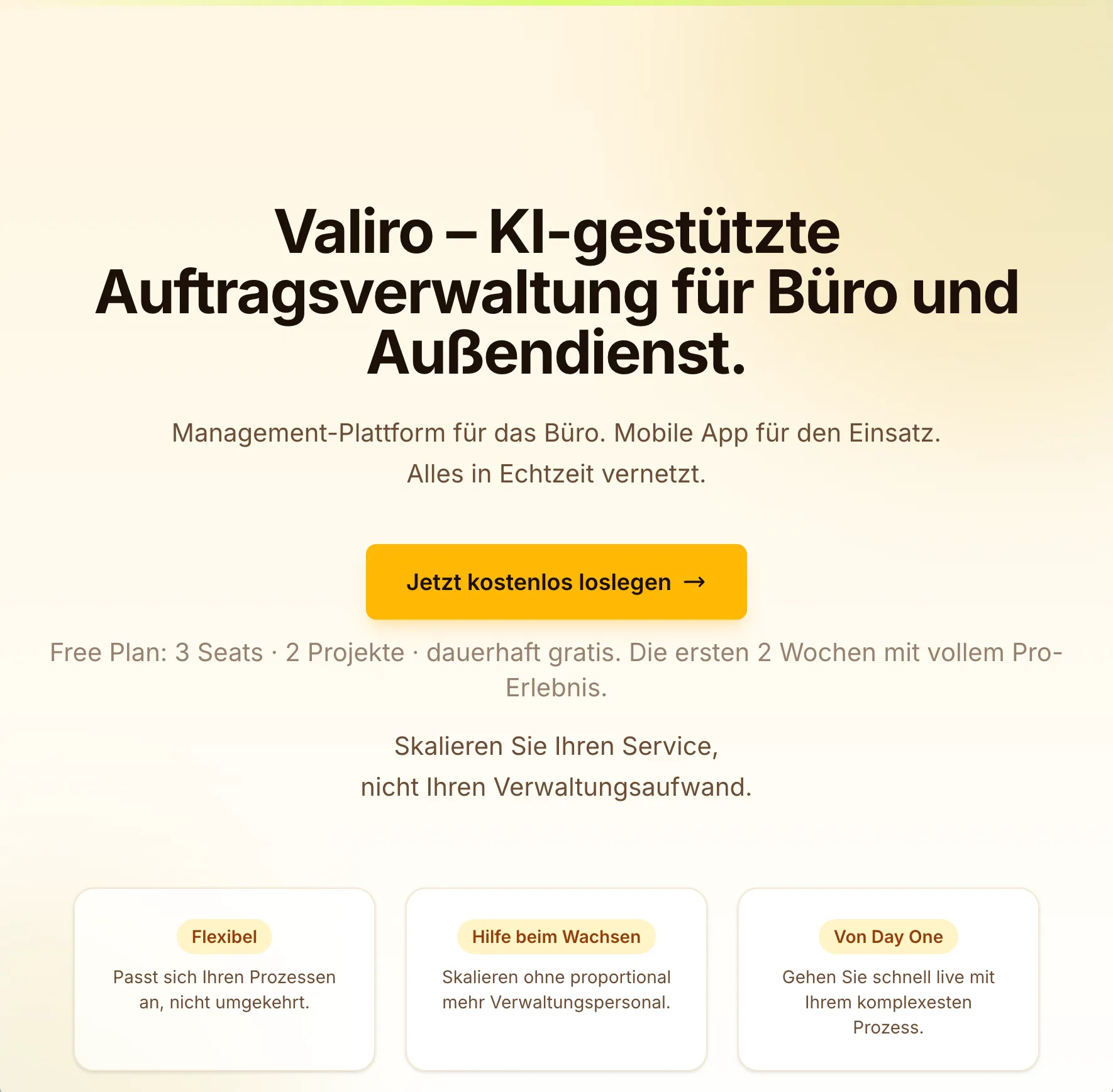
At construction and engineering firms two worlds run in parallel: the office holds projects, specs, contracts, and documents across an ERP, a DMS, mail inboxes, and shared drives. On the job site, in the workshop, at the customer's location stands the field worker — with no sensible way to access exactly the information they need right now.
The result: phone calls back to the office, half-hour waits, wrong parts, double work, frustrated staff. Existing solutions (Microsoft Teams, SharePoint, dedicated field-service suites) are either too generic, too cumbersome, or too expensive for mid-sized construction and engineering firms.
Valiro picks up exactly there: AI-powered search across all project and document corpora, mobile-first, offline-capable, with clean permission filters. People ask in natural language — the platform returns the right spec, the right photo, the right person to call.
Valiro was designed from day one as a mobile-first product. Not 'also on mobile' — but: the central user story is a field worker standing in the workshop, one hand free, needing fast answers. Everything else follows from that constraint.
Architecture: native iOS and Android apps on the field side. A web app for the office. Both connect to a shared API that orchestrates a vector store for AI search, classic Postgres for structured project data, and connectors to common ERPs. RAG with curated source references — so the AI doesn't hallucinate but points at the right PDF.
The hardest part wasn't the AI. The hardest parts were the operational ones: offline sync that resolves conflicts cleanly. Permissions that work end-to-end on document and project level. Adoption by people who've used different tools for twenty years. Performance on older phones in patchy LTE.
Every AI answer points at the concrete document and the exact passage. People only trust the AI if they can verify — and in construction that's not negotiable.
The app works without network. Sync is intelligent, with clear conflict rules and a UI that informs the user about conflicts rather than silently overwriting data.
We don't replace existing ERPs. We read from them, write back selectively, and respect the system of record. That has shortened the adoption path with mid-market clients enormously.
Models run in the EU, DPAs are clean, data flows documented. For construction/engineering firms with public-sector clients, this is often a precondition.
Field search latency is a KPI, not a detail. We measure response times under LTE-patchy conditions, not in fiber-optic offices.
Even when the first customer was the only one: multi-tenancy is in from day one. Migrating a single-tenant to multi-tenant is one of the most expensive architecture decisions — we avoided it.
Which LLM you use is usually the least important question. What matters is whether people actually open the solution — and that depends on UX, performance, and permissions, not the model.
In industrial, engineering, and construction settings, 'the AI says' is not acceptable. Every answer needs a verifiable source. That constrains the architecture — and prevents costly mistakes.
An AI solution that runs parallel to an existing ERP will die in industrial mid-market firms. It has to read from the ERP and write back selectively — otherwise you create shadow data.
I listen, ask questions, and tell you honestly whether and how I can help.